Hybrid IT Setup That Passes Audits and Stops Attacks
 Published on January 15, 2026
Updated on February 26, 2026
 7 mins to read
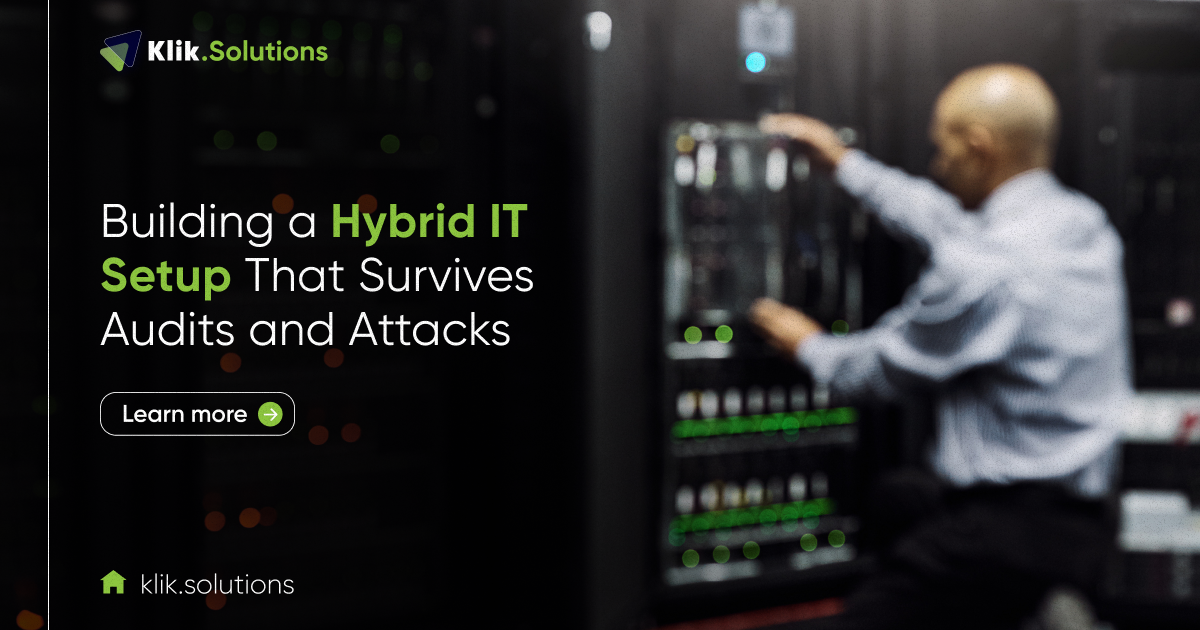
Hybrid IT did not become dominant because it was trendy. It became necessary. Organizations needed speed without surrendering control, innovation without abandoning legacy investments, and scalability without locking into a single vendor or model. Yet many hybrid environments now feel fragile. Audits uncover gaps leaders did not expect. Security teams struggle to see across systems. And attackers take advantage of the seams no one owns.
The problem is not that hybrid IT is too complex. The real issue is fragmentation. When infrastructure, cloud platforms, SaaS tools, and endpoints evolve without shared visibility or accountability, risk grows quietly. The most resilient hybrid environments are not built on more tools. They are designed around clarity, control, and ownership.
This guide is written for decision-makers who need hybrid environments that can scale, withstand audits, and resist modern threats without slowing the business down. It focuses on what actually works in 2026 and why.
What Hybrid IT Really Means in 2026
Hybrid IT today goes far beyond a data center connected to a public cloud. It now includes multiple cloud providers, dozens or hundreds of SaaS platforms, remote endpoints, edge devices, and third-party integrations. Identity lives in one place, workloads in another, data everywhere. In fact, hybrid and multi-cloud are now the norm. In 2024, 78% of organizations reported operating hybrid or multi-cloud (43% hybrid, 35% multi‑cloud) (Fortinet 2024 Cloud Security Report).
A modern hybrid IT setup is a living ecosystem. Infrastructure shifts constantly. Teams deploy new tools to solve immediate problems. Vendors update platforms weekly. Regulations evolve. This environment can support growth and innovation, but only if it is intentionally designed. Yet readiness is inconsistent. Over one-third of attacks in hybrid environments went undetected in the prior 12 months, and nearly half of leaders did not feel strongly prepared with their existing tools (Gigamon Hybrid Cloud Security 2024).
The challenge is that many hybrid environments were assembled, not built with intent. Each decision made sense in isolation. Together, they created blind spots. Understanding this reality is the first step toward building systems that can be trusted under pressure.
Why Hybrid Environments Fail Audits More Often Than Fully Cloud or On-Prem Setups
Audits rarely fail because of a single missing control. They fail because no one can confidently explain how controls work together across systems. Fully cloud or fully on-prem environments often benefit from consistency. Hybrid environments expose inconsistency.
Auditors look for evidence. They want to see how access is granted, how activity is logged, how data is protected, and how incidents are handled. In hybrid environments, answers often differ depending on the system. Policies exist, but enforcement varies. Logs exist, but they live in silos. Ownership is unclear. This inconsistency is increasingly consequential. Since December 2023, public companies must disclose material cybersecurity incidents within four business days of determining materiality, raising the bar on documentation, ownership, and response (SEC, https://www.ey.com/en_us/accountinglink/technical-line-a-closer-look-at-the-sec-s-new-rules-on-cybersecurity-disclosures).
This is where hybrid infrastructure compliance becomes difficult. Not because standards are unreasonable, but because hybrid environments amplify gaps between intention and execution.

Common Audit Red Flags in Hybrid IT
Most audit findings in hybrid environments fall into familiar categories. Access control is inconsistent across cloud, on-prem, and SaaS platforms. Logging is incomplete or retained inconsistently. Data residency is unclear, especially when SaaS tools replicate data across regions. Backup strategies differ by platform, creating uneven recovery capabilities.
These weaknesses directly correlate with higher breach costs—the global average breach cost reached $4.88M in 2024 (+10% YoY), with multi-environment incidents costing more and resolving more slowly (Zscaler on IBM 2024, Help Net Security on IBM 2024).
These red flags often surprise leadership because each system appears secure on its own. The issue is coordination. Without shared standards and oversight, hybrid environments behave like disconnected islands rather than a unified system.
Recognizing these patterns early allows teams to correct course before audits or incidents force the issue.
Security Gaps Caused by Tool Sprawl and Inconsistent Policies
Tool sprawl is one of the most underestimated risks in hybrid environments. Each tool promises protection, insight, or efficiency. Over time, overlapping capabilities emerge. Policies are configured differently. Alerts trigger in one system but not another.
This is how hybrid IT security quietly weakens. The operational burden of maintaining security tools increasingly pulls attention away from identifying and reducing real-world risk. Critical signals get lost in noise. Across providers, 89% report tool‑integration struggles and 56% experience daily/weekly alert fatigue; using 7+ tools nearly doubles fatigue—conditions directly linked to missed detections (Heimdal study, Digitalisation World coverage).
Consistency matters more than quantity. Fewer tools, clearly integrated, governed by shared policies, create stronger outcomes than complex stacks no one fully understands.

How Attackers Exploit Hybrid Complexity
Attackers rarely break down doors anymore. They slip through cracks. Hybrid environments offer many. A misconfigured SaaS permission here. An unmonitored service account there. An endpoint outside traditional network boundaries. Compromised credentials remain a top way in: ~38% of analyzed breaches involved stolen credentials in the 2024 Verizon DBIR, whereas phishing and exploitation trailed (Verizon DBIR 2024 PDF, ASIS summary).
In cybersecurity hybrid environments, attackers exploit delays in detection and confusion over ownership. They move laterally across systems that were never meant to work together seamlessly. The longer visibility gaps persist, the more damage can occur before anyone notices. Even though incident response has improved—median dwell time fell to 10 days in 2023 IR cases (and 5 days for ransomware)—that window remains enough for meaningful lateral movement and data staging (Mandiant M‑Trends 2024, Executive Edition, The Register coverage).
Defending against these threats requires seeing hybrid environments the way attackers do. As a connected whole, not a collection of independent systems.
The Role of Centralized Identity, Monitoring, and Incident Response
Centralized control points anchor resilient hybrid environments. Identity is the most critical. When identity is unified, access decisions become consistent. Privileges can be reviewed. Risk can be assessed in context.
Centralized monitoring brings activity into a single narrative. Logs tell a story when they are correlated. Alerts matter when they are prioritized. Incident response works when roles and processes are defined across environments.
These capabilities form the backbone of hybrid cloud security that scales without chaos. They allow teams to respond with confidence rather than scramble for answers.
Aligning Security Controls with Compliance Requirements
Compliance frameworks differ, but their intent overlaps. SOC 2 focuses on trust. HIPAA on data protection. GDPR on privacy. ISO on management systems. None were designed specifically for hybrid environments, yet all apply. An effective IT compliance strategy aligns controls to outcomes, not checklists. Identity governance supports access requirements across standards. Logging supports accountability. Incident response demonstrates preparedness.
Frameworks such as the NIST Cybersecurity Framework provide a flexible structure for mapping controls to business risk and compliance goals. Guidance from agencies like CISA reinforces practical, real-world security priorities. Used thoughtfully, these resources support alignment without rigidity.

Why Documentation and Visibility Matter as Much as Security Tools
Audits and incidents both demand proof. Not only do controls exist, but you must also understand, monitor, and maintain them. Documentation bridges this gap. It shows intent, ownership, and consistency.
Visibility ensures documentation reflects reality. Dashboards, reports, and reviews turn abstract policies into lived practice. Together, they form the foundation of an audit-ready IT infrastructure that withstands scrutiny.
Without documentation and visibility, even strong security controls lose credibility.
Design Principles for Audit-Ready Hybrid IT Environments
Successful hybrid environments share common design principles. They prioritize shared identity over fragmented credentials. They centralize logging and monitoring. They define ownership clearly. They document decisions and review them regularly.
Most importantly, they assume change. Systems evolve. Regulations shift. Teams grow. Design must accommodate this reality rather than resist it.
These principles reduce hybrid IT risks by creating environments that adapt without losing control.
Ongoing Governance vs. One-Time Compliance Prep
Compliance cannot be a seasonal activity. One-time preparation leads to temporary fixes and lasting fatigue. Governance, on the other hand, integrates compliance into daily operations.
Regular reviews, automated evidence collection, and shared accountability turn compliance into a continuous process. This approach reduces stress, improves security, and supports growth rather than constraining it.
Organizations that adopt this mindset experience fewer surprises and stronger outcomes.

How IT Leaders Can Future-Proof Hybrid Setups as Regulations Evolve
Regulations will continue to expand. Privacy expectations will rise. Threats will grow more sophisticated. Future-proofing hybrid environments means building adaptability into governance, architecture, and culture.
Leaders who invest in visibility, control, and accountability position their organizations to respond confidently. They create environments that support innovation without sacrificing trust. Hybrid IT can be resilient, scalable, and compliant when it is designed intentionally.
Hybrid IT is not a temporary phase. It is the operating reality for modern organizations that need to move fast without losing control. When designed intentionally, hybrid environments can support innovation, satisfy regulators, and withstand real-world attacks. When left fragmented, they quietly accumulate risk until an audit or incident exposes the cracks.
The strongest hybrid environments are not defined by how many tools they use. They are defined by how clearly responsibility is assigned, how consistent controls are applied, and how confidently leaders can explain what is happening across their systems. Visibility, governance, and accountability are what turn complexity into resilience.
For IT leaders, the opportunity is clear. A well-architected hybrid environment does more than reduce risk. It creates trust with customers, regulators, and internal stakeholders. It enables growth without fear of disruption. And it provides peace of mind that security and compliance are not afterthoughts, but built-in capabilities that evolve with the business.
Evaluate whether your hybrid IT environment is audit-ready and attack-resilient before regulators or attackers test it for you.
Frequently Asked Questions
What is a hybrid IT setup?
It is an environment that combines on-prem infrastructure, cloud platforms, SaaS applications, and endpoints into a single operational ecosystem.
Why are hybrid environments harder to secure?
They introduce multiple control planes, identities, and data locations, which increases complexity and the risk of inconsistent policies.
How does hybrid IT impact compliance audits?
Audits become more challenging when controls differ across systems and documentation does not clearly show how requirements are met end to end.
Can hybrid IT be as secure as fully cloud-based systems?
Yes, when designed with centralized identity, monitoring, and governance, hybrid environments can meet or exceed security expectations.
What are the biggest risks in a hybrid IT infrastructure?
Lack of visibility, inconsistent access control, tool sprawl, and unclear ownership are the most common risks.
How often should hybrid IT environments be reviewed for compliance?
Reviews should be continuous, with formal assessments at least annually and after major system changes.